10 Best Digital Adoption Solutions in 2026
Digital adoption solutions are software that sits on top of your business applications and guides people through tasks inside them. They’re also called digital adoption platforms (DAPs) or DAP solutions.
The best digital adoption solutions for you depend on which applications you need to cover. For guidance, automation, and AI assistance across many enterprise applications, compare WalkMe, Whatfix, and Lemon Learning.
For product analytics with in-app guides, look at Pendo. For Oracle applications, consider Oracle Guided Learning. For training content and documentation, look at ClickLearn and uPerform.
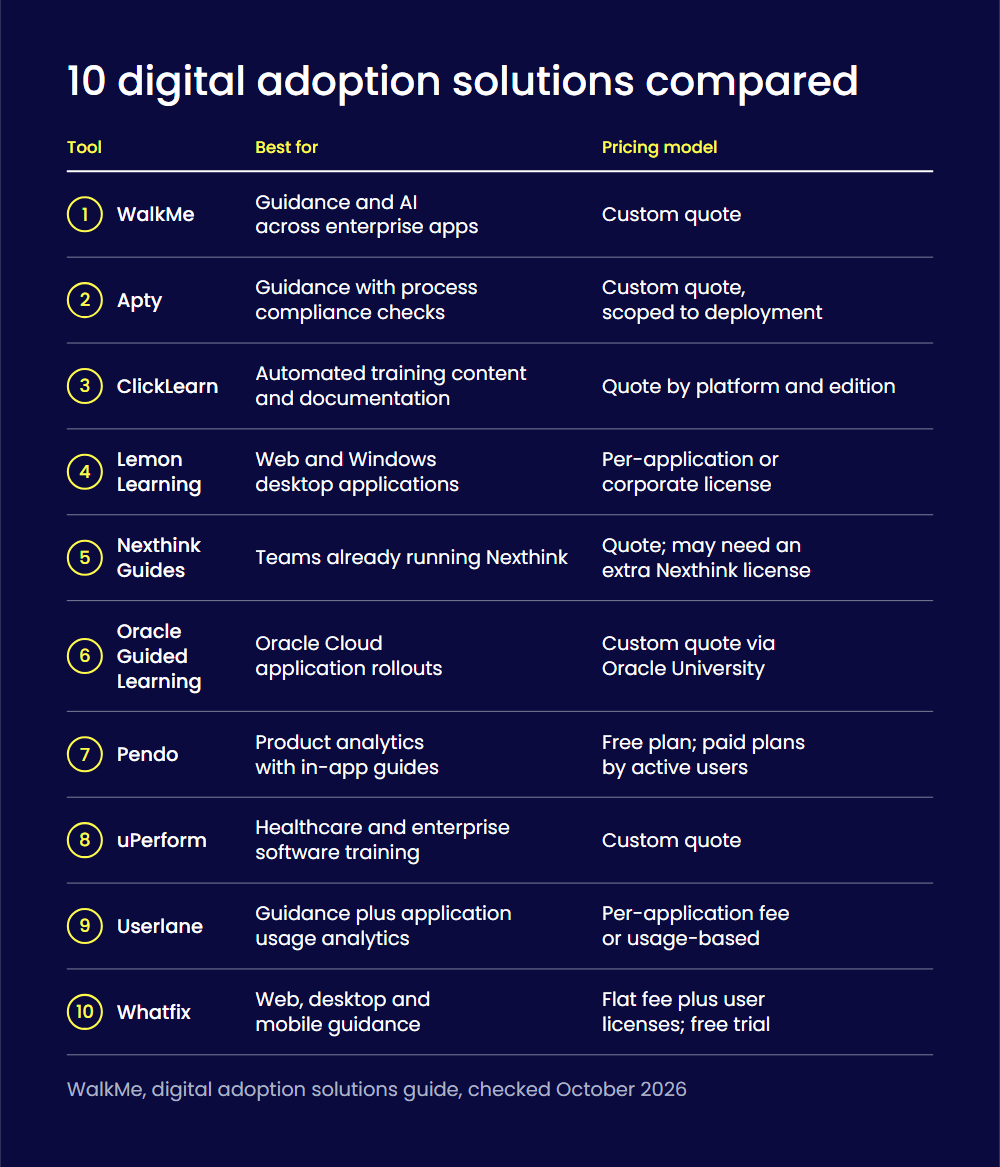
| Tool | Best for | Pricing model |
| WalkMe | Guidance and AI across enterprise apps | Custom quote |
| Apty | Guidance with process compliance checks | Custom quote, scoped to deployment |
| ClickLearn | Automated training content and documentation | Quote by platform and edition |
| Lemon Learning | Web and Windows desktop applications | Per-application or corporate license |
| Nexthink Guides | Teams already running Nexthink | Quote; may need an extra Nexthink license |
| Oracle Guided Learning | Oracle Cloud application rollouts | Custom quote via Oracle University |
| Pendo | Product analytics with in-app guides | Free plan; paid plans by active users |
| uPerform | Healthcare and enterprise software training | Custom quote |
| Userlane | Guidance plus application usage analytics | Per-application fee or usage-based |
| Whatfix | Web, desktop and mobile guidance | Flat fee plus user licenses; free trial |
Enterprises keep buying software and AI tools, yet the value depends on people using them well. That’s the adoption gap, and it rarely comes from the software alone. People get stuck inside the application, in the middle of a task. A digital adoption solution closes that gap where it opens: on the screen, at the moment of work.
These 10 solutions suit enterprise IT, HR, operations, and learning teams choosing a tool for employee-facing or customer-facing software. If you only need onboarding inside your own SaaS product, compare user onboarding tools.
The 10 best digital adoption solutions
WalkMe comes first because it’s our product. The other nine follow in alphabetical order.
1. WalkMe
Best for: Large enterprises that need guidance, automation, and AI assistance across many applications, for employees or customers.
What it is: WalkMe’s AI-enabled Action Bar reads context across the screen and suggests the next best action, so help arrives before people ask for it. WalkMe is a digital adoption platform that acts as an execution and accountability layer across your applications, providing real-time context, cross-application workflows, and automation. It works on web, mobile, and desktop applications, and it is part of SAP. IBM reports 6X higher user retention and 4X better conversion rates from trials to subscriptions.
Key features:
- Action Bar across applications: AI assistance sits inside the applications people already work in, so people don’t learn a new help system for each tool.
- In-app guidance: Interactive in-app guides, tooltips, and notifications help people through tasks inside the application.
- Automation: WalkMe can automatically click buttons, select menu items, and autofill forms and fields, which cuts time spent on repetitive processes.
- Adoption analytics: Usage data shows trends in completion, drop-off, and engagement, within and across applications.
- Security: WalkMe lists its certifications, including SOC 2 Type 2 and ISO/IEC 27001, on its Trust Center.
Limitations: Pricing isn’t published; you request a quote. Your contract sets how many WalkMe systems (applications) you can use, as the Contracts page in Admin Center shows. Mobile apps need the WalkMe Mobile SDK built into the app.
Pricing: Custom quote; no free plan or free trial listed on WalkMe’s pricing page (checked Oct 2026).
Rating: 4.5/5 on G2’s WalkMe reviews, 582 reviews (checked Oct 2026).
2. Apty
Best for: Enterprises that want in-app guidance plus checks to ensure people follow the process correctly.
What it is: Apty is an AI-powered digital adoption platform built to improve how work gets done inside enterprise applications. It combines in-app guidance, walkthroughs, validations, and adoption analytics. A separate product, Apty PULSE, gives a holistic view of software utilization across your organization.
Key features:
- In-app guidance: In-app guidance, tooltips, and contextual help support people as they finish tasks inside the application.
- Workflow validations: Walkthroughs and validations support the right actions in the workflow, improving quality and accuracy.
- Analytics: Usage, process, completion, and friction analytics show where a process slows down.
- Live adoption signals: Live workflow monitoring and early risk and compliance alerts help teams stay ahead of workflow breakdowns.
- Apty PULSE: A centralized dashboard shows software utilization, adoption trends, and usage patterns across your organization.
Limitations: Pricing isn’t published. On-premise authoring, white-labeling, and professional services are optional add-ons.
Pricing: Custom quote scoped to your requirements, typically by users, applications, implementation, integration, deployment, or compliance needs, with no feature-based tiers. No free trial listed (checked Oct 2026).
Rating: 4.7/5 on G2’s Apty reviews, 147 reviews (checked Oct 2026).
3. ClickLearn
Best for: Teams that need training material and documentation for ERP and CRM systems, kept current as the software changes.
What it is: ClickLearn is a digital adoption platform built around automatically creating training material and documentation. You record a work process once, and ClickLearn produces the content from that recording. Its Virtual Assistant adds live guidance inside business applications. Supported applications include Microsoft Dynamics, SAP, Oracle, IFS, Acumatica, and Salesforce.
Key features:
- Process recording: Record a work process inside your system, and ClickLearn turns each step into a step-by-step guide.
- Seven output formats: One recording becomes seven formats: three video formats, Word, PDF, and PowerPoint documents, and a Virtual Assistant.
- Replay: Content updates automatically when the software changes, so documentation stays current.
- Translation: Training courses can be produced in 45 languages.
- Virtual Assistant: Live user guidance and a real-time assistant help people who get stuck in a process.
Limitations: Features depend on the edition: LMS and SCORM integration come with the top edition, for larger organizations. Onboarding services are sold separately at a fixed price.
Pricing: Custom quote from an online pricing configurator, by platform and edition; Oracle, IFS, and SAP need tailored pricing. No free trial listed (checked Oct 2026).
Rating: 4.5/5 on G2’s ClickLearn reviews, 40 reviews (checked Oct 2026).
4. Lemon Learning
Best for: Enterprises that need guidance in both web applications and Windows desktop tools, including older SAP screens.
What it is: Lemon Learning is a digital adoption platform that brings in-app guidance to business applications such as Salesforce, SAP, and Workday. It says it works on 300+ applications and also runs on in-house web apps and desktop tools such as SAP GUI.
Key features:
- Interactive guides: Step-by-step guides, tooltips, and contextual help guide employees through tasks inside the applications they already use.
- Announcements: In-app banners, modals, and tooltips reach people when they open the relevant page.
- Guidance analytics: Real-time adoption KPIs and guide completions show how people use your guides.
- AI assistant: An AI guide creator drafts guides, and the in-app AI Assistant answers from your published content.
- No-code editor: Business teams build and update guides without developer help.
Limitations: Pricing isn’t published. Onboarding and implementation is a paid service, included in your quote. Lemon Learning says it is hosted in Europe, so check fit if you need US hosting.
Pricing: Custom quote: an Application license for one tool, priced by application type and user count, or a Corporate license for unlimited applications, priced by total user count. There’s no self-serve free trial; Lemon Learning offers a 30-minute live demo instead (checked Oct 2026).
Rating: 4.8/5 on G2’s Lemon Learning reviews, 45 reviews (checked Oct 2026).
5. Nexthink Guides
Best for: IT teams that already run Nexthink and want guidance inside browser-based applications.
What it is: Nexthink Guides, which replaces the standalone Nexthink Adopt, is a digital adoption solution that overlays browser-based applications. It provides in-app guidance, on-demand training, and analytics on how employees use each application. It runs within Nexthink’s Applications module, part of the Nexthink platform for digital employee experience.
Key features:
- Walkthroughs: Step-by-step guidance that takes people through a task flow.
- Tooltips: Contextual information appears when people hover over or use specific elements in the application.
- Context help: A Context help pop-up gives people access to guides and embedded media or articles for self-help.
- Guide analytics: Duration, completion, and drop-off rates show which guides work.
- Recording and AI suggestions: Guides captures each interaction you record and converts it into a step, and AI suggestions remove redundant steps.
Limitations: Guides isn’t sold on its own: it relies on Nexthink’s Applications module and may require an additional license. Firefox doesn’t support it. It covers browser-based applications and needs the Nexthink browser extension and Collector on each device.
Pricing: Custom quote through a Nexthink representative; no free trial listed (checked Oct 2026).
Rating: 4.6/5 on G2’s Nexthink reviews, 397 reviews, for the Nexthink platform as a whole (checked Oct 2026).
6. Oracle Guided Learning
Best for: Organizations rolling out Oracle Fusion Cloud and other Oracle applications.
What it is: Oracle Guided Learning is a digital adoption platform that delivers in-application guidance across cloud applications. Oracle offers it through Oracle University. It is embedded in Oracle applications, and Oracle says customers can also use it in non-Oracle applications such as Salesforce, ServiceNow, and Microsoft 365.
Key features:
- Process guides: In-app guides, such as tours, process guides, and simulations, walk users through a task in the system.
- In-app messaging: Announcements, newsletters, and maintenance updates reach users in the application, and beacons draw attention to new features.
- Tooltips: Tooltips provide contextualized guidance as users complete processes.
- Embedded analytics: Reports measure adoption outcomes, guide effectiveness, and usage.
- AI Assist: AI suggests content text and translates it into other languages.
Limitations: Oracle sells it through Oracle University and doesn’t publish a price. Outside Oracle’s own applications, Oracle describes it as compatible with web applications, so confirm coverage for any desktop tools.
Pricing: Custom quote through Oracle University sales. No free trial listed (checked Oct 2026).
Rating: 4.7/5 on G2’s Oracle Guided Learning reviews, 8 reviews (checked Oct 2026).
7. Pendo
Best for: Teams that want product analytics and in-app guides together, for customer-facing products and employee software.
What it is: Pendo is a product analytics and in-app guidance platform. Product teams use it on the applications they build. Pendo for Employees applies the same tools to internal software, giving IT and operations teams visibility into internal tools, whether they built them or bought them. Pendo says you can deploy it on web, mobile, and AI applications.
Key features:
- Product analytics: Pendo tracks engagement and retention without manual event tagging.
- In-app guides: Segmented, targeted guides, walkthroughs, and tooltips reach people inside the application.
- Session replay: Recordings show what users did click by click, with frustration signals flagged.
- Portfolio: Compare adoption, engagement, and retention across your applications.
- AI guide creation: The AI guide builder creates in-app guides from simple prompts.
Limitations: The free plan stops at 500 monthly active users, and paid plans are priced on monthly active users. Session Replay isn’t included in the entry paid plan. Employee-facing deployments typically use the Pendo Launcher browser extension; the Resource Center works there but isn’t available on the mobile SDK.
Pricing: Pendo Free for up to 500 monthly active users; paid plans by custom MAU volume. A 30-day free trial is offered (checked Oct 2026).
Rating: 4.4/5 on G2’s Pendo reviews, 1,819 reviews (checked Oct 2026).
8. uPerform
Best for: Health systems and large enterprises training staff on Epic and other EHR, ERP, and HCM systems.
What it is: uPerform is a healthcare-focused digital adoption and learning platform. It helps organizations create and deliver role-based training, in-application guidance, performance support, and change communications. Content appears inside EHRs, ERPs, HCMs, and other mission-critical systems, where people do their work.
Key features:
- Workflow recording: Record a workflow once and publish it as tip sheets, videos, and interactive simulations.
- In-application help: uPerform gives users access to microlearning directly in the workflow of their critical applications.
- Learning Pathways: Role-based, self-paced learning gets new hires into their roles faster.
- Change Communications: uPerform keeps users informed on upcoming changes, and when paired with Copilot, it delivers only the alerts relevant to each user in their workflow.
- Reporting: Analytics integrate with visualization software such as Microsoft Power BI and Epic Signal data.
Limitations: uPerform is built first for healthcare, so check the fit for other industries. Pricing isn’t published.
Pricing: Custom quote; pricing isn’t published. No free trial listed (checked Oct 2026).
Rating: 4.3/5 on G2’s uPerform reviews, 41 reviews (checked Oct 2026).
9. Userlane
Best for: Enterprises that want in-app guidance and usage analytics across the applications their employees use.
What it is: Userlane describes itself as the platform for enterprise software performance. It combines Application Intelligence, which shows where technology creates cost and friction, with Contextual Assistance, which helps people get work done inside their applications. Userlane names healthcare, financial services, manufacturing, and pharma among the industries that use it.
Key features:
- Interactive guides: Authors create guides, tooltips, and tags in the live application within minutes.
- HEART analytics: Usage data reveals friction points and interaction patterns.
- App Discovery: A browser extension shows which applications employees use across the organization.
- Userlane Assistant: The main navigation tool for your content gives users access to all of your Guides and Messages.
- AI Assistant: Users ask a question in their own words and get an answer drawn from your published content.
Limitations: Pricing isn’t published. Userlane deploys mainly through a browser extension, with a JavaScript snippet for external-facing apps or mobile web; App Discovery runs through the browser extension.
Pricing: Custom quote: a fixed annual fee per application, or consumption-based pricing for unlimited applications. No free plan or free trial listed (checked Oct 2026).
Rating: 4.7/5 on G2’s Userlane reviews, 81 reviews (checked Oct 2026).
10. Whatfix
Best for: Enterprises covering web, desktop, and mobile applications, for employees or customers.
What it is: Whatfix is a digital adoption platform with three products: in-app guidance (DAP), Mirror for simulation training, and Product Analytics. It says it can overlay any enterprise software or custom application, including web, desktop, and mobile apps, as well as VDI (Citrix) environments. Plans are available for employee-facing and customer-facing applications.
Key features:
- In-app guidance: Flows, Smart Tips, Task Lists, and Self Help guide people inside the application.
- Mirror: Simulation training and roleplay give people hands-on practice before go-live.
- Product Analytics: Usage data helps teams identify friction, measure outcomes, and optimize adoption.
- AI agents: Whatfix uses AI agents to author and update content and adapt guidance based on user behavior.
- Mobile: Guidance extends to mobile apps as well as web and desktop.
Limitations: Some features depend on the plan (the Standard plan is limited to 2 integrations), and Session Replay is a paid add-on.
Pricing: Custom quote across Standard, Premium, and Enterprise plans, made up of a flat fee plus user license fees. A free trial is offered (checked Oct 2026).
Rating: 4.5/5 on G2’s Whatfix reviews, 554 reviews (checked Oct 2026).
How to choose a digital adoption solution
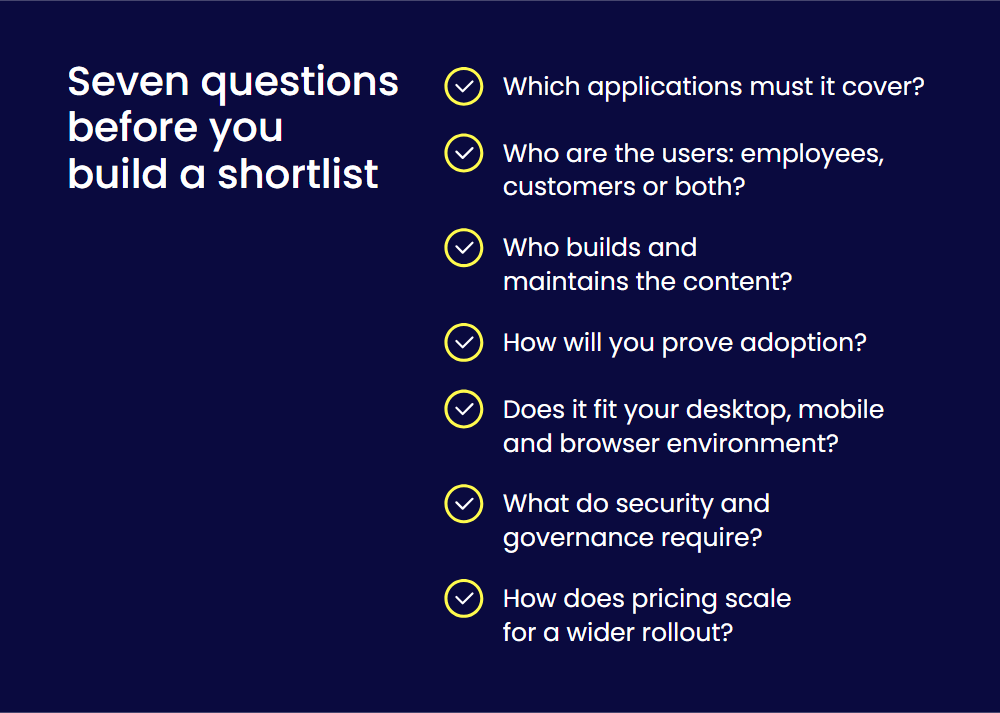
Work through these questions before you build a shortlist.
- Which applications must it cover? A tool tied to one vendor’s suite suits a single rollout. A stack of many applications needs a solution that works across them all.
- Who are the users? Some solutions focus on employees, some on customers, and some serve both.
- Who builds and maintains the content? Check how much the authoring tool asks of your team, and how content stays current after software updates.
- How will you prove adoption? Look for analytics that show usage, completion, and friction, not only guide views.
- Does it fit your environment? Confirm support for desktop, mobile, and virtual desktops, and for the browsers your company allows.
- What do security and governance require? Review certifications, hosting regions, and permissions early.
- How does pricing scale? Most vendors quote by users, applications, or usage, so model costs for a wider rollout.
If your main goal is employee training, compare dedicated employee training software, too. For a longer evaluation framework, read the digital adoption platform buyer’s guide. To see how three enterprise platforms compare on security, AI, and analytics, read which digital adoption platform is best for enterprise.
How we chose these solutions
We kept the list to enterprise application solutions. We left out tools built mainly for onboarding inside a single SaaS product, and tools that only produce documentation.
We compared each solution on six criteria:
- in-app guidance for enterprise applications,
- coverage across applications,
- analytics on adoption,
- integrations,
- pricing transparency,
- verified review ratings.
Features, plans, and pricing models come from each vendor’s own product, pricing, documentation, and help pages. Ratings come from G2, with review counts. We checked every fact in October 2026. WalkMe is our product, so it appears first.
Turn software investment into adoption
Buying software is the easy part. The return comes later, when people use it well, every day, across every application.
That matters even more as companies add AI tools to their stack. An assistant only helps if people use it in their real workflows, and if you can see that they do. WalkMe turns AI potential into AI performance. Its AI-enabled Action Bar reads context across the screen and suggests the next best action inside the applications people use, and its analytics show completion, drop-off, and engagement, so you can prove adoption.
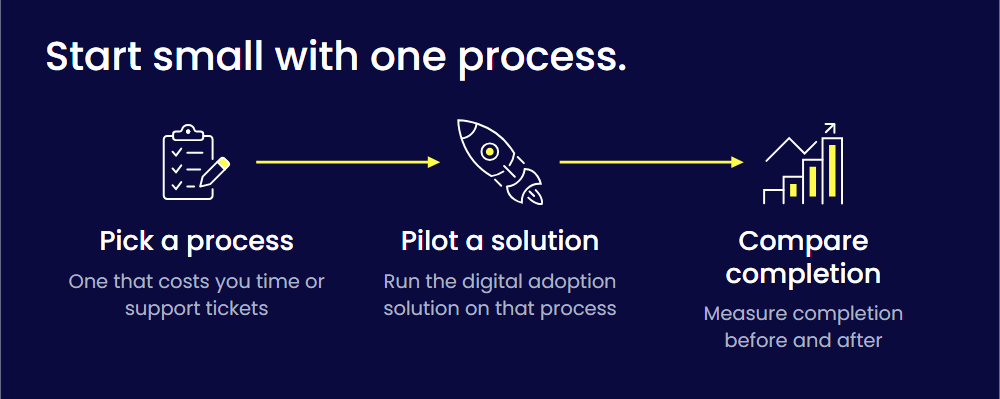
Start small. Pick one process that costs you time or support tickets, pilot a solution on it, and compare completion before and after. If you need the plan before the tool, read our guide to digital adoption strategy.
FAQs
A digital adoption solution is software that sits on top of a business application and guides people through tasks inside it. It adds on-screen guidance, automation, and analytics, so employees and customers can use the application fully. For a longer explanation of how the technology works, read the glossary entry on the digital adoption platform.
DAP stands for digital adoption platform. In software, a DAP is a layer that runs on top of other applications and gives users in-app guidance. “DAP solutions” and “digital adoption solutions” mean the same thing. Outside software, DAP has unrelated meanings.
Start with the applications you need to cover and the people who use them. Then check how content is built and maintained, what the analytics can prove, and how the solution handles security and governance. Ask each vendor for a quote based on your real user and application counts, because most enterprise pricing isn’t published.
Look for in-app guidance that works across your applications, automation for repetitive steps, and analytics that show where people get stuck. A no-code editor matters if business teams will build the content. Enterprise buyers should also check integrations, supported browsers and devices, and published security certifications.
Most run as a layer on top of the application, delivered through a browser extension or a code snippet. Some are embedded in one vendor’s applications, as Oracle Guided Learning is in Oracle’s. Others, such as Nexthink Guides, depend on a wider platform. Desktop and mobile apps may need extra setup, so confirm coverage for each application you plan to support.
A digital adoption solution helps people become productive in new software sooner, because guidance appears inside the application as they work. It can reduce support requests, since users find answers on their own. Its analytics also show which processes cause friction, so you can fix them and get more from the software you’ve bought.